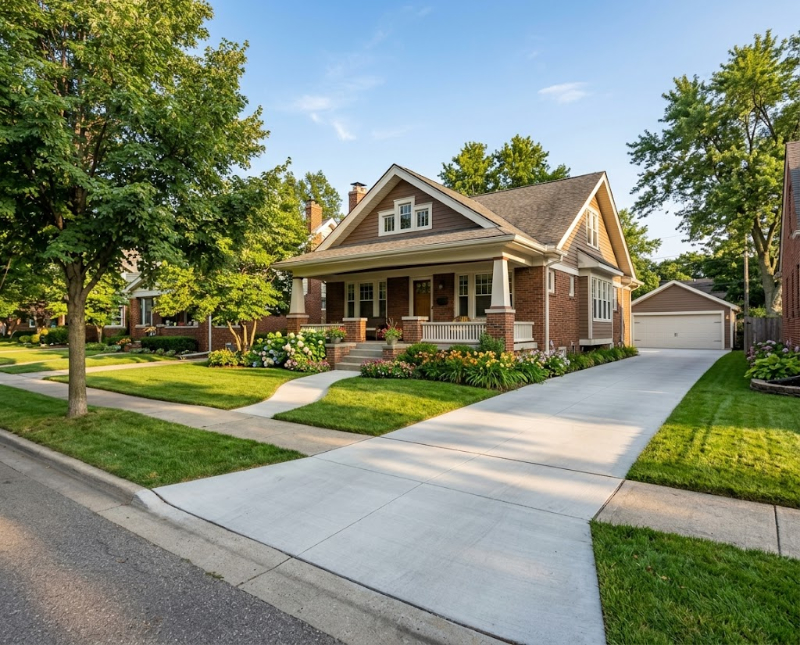
There is a window each year when installing concrete in Oakland County is genuinely ideal. Temperatures are in the right range, the ground has dried from the spring thaw, and the long days give crews the time they need to do the job correctly. That window is open right now in Royal Oak and Clawson. And for homeowners who have been putting off a driveway replacement, the time is running out.
Flat Rock Concrete Construction, based in Utica, serves homeowners throughout Oakland County, including Royal Oak and Clawson. Late spring is one of the two best times of year to pour concrete in Michigan — the other is early fall. If you miss this window, your next realistic opportunity is September, and by then, the schedule at every quality concrete contractor in the area fills up fast. Here is why that timing matters and what you should know before you call.
Why Late Spring Is the Right Time to Pour Concrete in Michigan
Concrete is not simply a material that gets poured and hardens — it is an ongoing chemical reaction. The cement particles in the mix hydrate, binding with water to form the crystalline matrix that gives concrete its strength. That reaction is temperature-dependent. Pour concrete when temperatures are below 40 degrees, and the hydration reaction slows dangerously. Pour when temperatures are above 90, and the surface dries too fast, producing a weakened surface layer prone to cracking and scaling.
Late spring in the Royal Oak and Clawson area provides conditions that make concrete installation straightforward: daytime temperatures typically in the 60s and low 70s, nights safely above freezing, and no weather extremes at either end of the thermometer. The mix cures at the right pace. The surface can be properly finished. The curing compound has time to work before heat or cold becomes a factor.
There is also a ground condition element. By late May, the sub-base has fully dried from spring thaw. A dry, properly compacted sub-base is what gives a concrete driveway its long-term stability. Work done on saturated or frost-affected ground — even when the surface appears fine — is susceptible to settling and cracking within the first few years. The window when ground conditions and air temperatures are both right is narrower than most homeowners realize.
Royal Oak and Clawson: A Market That Values Property Condition
Royal Oak and Clawson are two of Oakland County’s most active real estate communities. Properties in both cities see strong buyer interest, and homeowners in these neighborhoods have learned that exterior condition — including the driveway — plays a real role in both sale price and time on market.
Royal Oak in particular has seen significant reinvestment over the past decade. The mix of original mid-century homes alongside renovated properties means buyers are used to comparing well-maintained homes against ones where deferred maintenance is visible at the curb. A driveway that is cracked, spalling, or showing its age is not a neutral detail in this market. It is a signal — to buyers, to neighbors, and to anyone pulling up to the house for the first time — that the property has not been fully kept up.
A fresh concrete driveway sends the opposite signal. It reads as an investment in the property. In established neighborhoods like those in Royal Oak and Clawson, where the homes are often decades old, a new driveway is one of the most visible improvements a homeowner can make.
What Happens If You Wait Until Midsummer?
Summer concrete work in Michigan is done every day, and it can be done well. But it requires additional precautions that late spring does not. When temperatures push into the mid-80s and above, crews need to manage the concrete mix and the curing process much more carefully — adding ice to the mix water, coordinating pours for early morning when temperatures are lower, and applying wet curing blankets or additional curing compound to keep the surface from drying too fast.
These adjustments are effective, but they add complexity and can add cost. More importantly, summer in Oakland County is peak season for concrete work. Quality contractors — the ones who are not cutting corners — are booked. A homeowner who calls in late June is often looking at a July or August installation date, which pushes the project into the year’s hottest and most difficult conditions.
The homeowners who get the smoothest experience are consistently the ones who engage a contractor in late May or early June. They get ideal weather conditions, a contractor who is not rushed, and a driveway that cures under the best possible circumstances. Waiting until summer means competing for calendar time and working against the weather rather than with it.
Signs Your Royal Oak or Clawson Driveway Is Past Due
Many homeowners in established neighborhoods like Royal Oak and Clawson are living with driveways installed in the 1980s or earlier. Concrete driveways have a design life of 30 to 50 years — but that range assumes a quality installation and reasonable maintenance. Many older driveways received neither, and the cumulative effect of 30 or 40 Michigan winters shows it.
- Widespread cracking across multiple slab sections, particularly cracking that forms a map pattern rather than following control joints
- Surface spalling — areas where the top layer of concrete is flaking, pitting, or breaking away from the slab beneath
- Sections that have heaved or settled relative to each other, creating lips or drops at joints
- Water pooling on the surface after rain rather than running off toward the street
- An overall worn or degraded appearance that affects the curb appeal of an otherwise well-maintained home
In Royal Oak and Clawson, where the housing stock includes many homes built between 1940 and 1980, it is common to find driveways that are overdue for replacement but have been maintained with patches and sealers long past the point where that approach makes sense. A patch can slow deterioration, but it cannot reverse it. If the driveway’s underlying structure is compromised, replacement is the only honest solution.
The Flat Rock Concrete Installation Process
Every Flat Rock Concrete driveway project starts with a free on-site estimate. We come to your Royal Oak or Clawson property, assess the existing driveway, evaluate the sub-base conditions, and give you an honest recommendation. If targeted repairs are a viable option, we will tell you that. We are not in the business of selling full replacements when they are not needed.
When replacement is the right call, we handle demolition and removal of the existing driveway — breaking up and hauling away all old material. The sub-base is then graded, compacted, and built to the appropriate depth, typically four to six inches of compacted aggregate. This is the foundation of your new driveway, where the installation’s longevity is determined. We do not cut corners here.
Forms are set to establish the finished edges and ensure proper drainage slope away from the home’s foundation. Reinforcement — wire mesh or rebar depending on the project — is installed within the form. The concrete is then poured, screeded level, floated, and finished with a broom texture. Control joints are cut at regular intervals across the slab to manage stress cracking. A curing compound is applied immediately after finishing to protect the surface during the critical early curing period.
We advise homeowners to keep foot traffic off the new driveway for at least 48 hours and vehicles off for a full 7 days. By that point, the concrete has reached approximately 70 percent of its design strength. Full strength is reached over the next 28 days, and the slab continues to gain strength gradually for months afterward.
Contact Flat Rock Concrete Construction Today
The late-spring installation window in Royal Oak and Clawson is now open. If you have been thinking about a new driveway — whether you are planning to sell, improving for the long term, or simply tired of a driveway that no longer reflects the quality of your home — this is the right time to move. Contact Flat Rock Concrete Construction for a free estimate. We will come out, take an honest look at your property, and give you a clear picture of what a quality installation would involve.