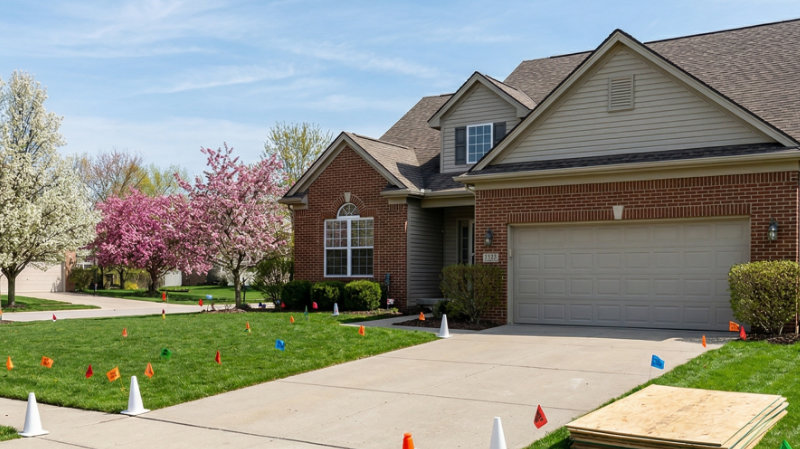
You’ve made the decision, gotten your estimate, and scheduled your new concrete driveway installation for this spring. For homeowners in Auburn Hills and Rochester, that’s an exciting milestone — a new driveway is one of the most visible and satisfying home improvements you can make. But before the concrete truck arrives, there are steps you can take to prepare your property that will make the installation process smoother, faster, and better for the long-term quality of the finished product.
Flat Rock Concrete Construction has installed driveways throughout Auburn Hills, Rochester, and East Oakland County for years. In that time, we’ve seen how a well-prepared site contributes to a smooth project and how a lack of preparation can lead to delays, complications, and, occasionally, compromised results. This guide provides a clear, practical checklist for preparing your property for a spring driveway installation.
Step 1: Understand the Full Scope of the Project
Before you can prepare your property, you need a clear picture of what the project actually involves. If you haven’t already walked through the full project scope with your contractor, do that first. Specifically, you want to understand the following:
- What area exactly is being demolished and replaced? Confirm the boundaries of the work — where the new driveway starts and ends, and whether any adjacent concrete (like an existing apron, sidewalk connection, or side pad) is included.
- How will demolition debris be removed? Broken concrete is heavy and requires a dump truck for removal. Confirm where the truck will be positioned and how debris will be loaded — this affects which areas of your yard or landscaping need to be protected or cleared.
- Where will the concrete truck access the pour site? Ready-mix concrete trucks are large and heavy — typically 70,000 pounds when loaded. They need a clear, firm path to approach the pour site. Understand the planned route and whether any obstacles need to be addressed.
- What is the expected timeline? How many days of active work are planned? What is the earliest you can park on the new surface, and what care instructions will you receive after the pour?
Step 2: Handle Permits Early
Both Auburn Hills and Rochester may require permits for driveway installation or replacement, depending on the scope of work and whether any connection to public infrastructure (like a curb cut or public sidewalk) is involved. Your contractor should be familiar with local requirements, but it’s worth confirming who is responsible for pulling the permit and whether any inspections are required.
Permit processing times vary — in some communities, it’s a matter of days, in others, it can take one to two weeks. Starting the permit process as early as possible ensures it doesn’t become a scheduling bottleneck when good weather arrives, and you’re ready to move forward.
While you’re at it, call MISS DIG (dial 811 in Michigan) if your contractor hasn’t already arranged it. Michigan law requires that underground utilities be located and marked before any excavation. This protects your gas, water, electrical, and communications lines from accidental damage during demolition and excavation — and it protects you from liability if an unmarked line is damaged. MISS DIG requests must be submitted at least 3 business days before excavation begins.
Step 3: Clear the Work Zone
In the days before your installation begins, clear everything from the area affected by the work. This includes more than just the driveway itself — think about the full footprint of equipment access and material staging.
- Move all vehicles from the driveway and from any area the concrete truck will need to access. Arrange alternative parking for the duration of the project — remember you won’t be able to use the new driveway for at least seven days after the pour.
- Remove basketball hoops, mailboxes on driveway posts, or any other structures anchored in or immediately adjacent to the driveway. Discuss with your contractor in advance which items they will handle as part of the project and which are your responsibility.
- Move landscaping containers, garden tools, lawn furniture, and any other movable items well clear of the work zone. Concrete work generates debris, vibration, and foot traffic across adjacent areas.
- In spring, be mindful of soft lawn areas adjacent to the driveway. Equipment access during demolition and base preparation can cause ruts in soft, wet spring turf. If your lawn is particularly soft, discuss access routes with your contractor to minimize damage. Some homeowners lay plywood panels over vulnerable turf areas to distribute the weight of equipment.
Step 4: Address Landscaping and Tree Root Concerns
Spring is when landscaping in Auburn Hills and Rochester is just beginning to emerge, and it’s worth carefully considering how the installation will interact with plantings near the driveway.
Tree roots are a particular concern. Mature trees with roots that extend beneath or near the driveway can be affected by excavation work, and the roots in turn can affect the new driveway over time. Discuss with your contractor where significant roots are located and how the excavation plan accounts for them. In some cases, roots that have been causing heaving in the old driveway need to be cut or addressed as part of the demolition process — ideally with input from an arborist if the tree is significant.
Perennial plantings and shrubs along the driveway edge should be assessed before demolition begins. If any are in the direct path of the new driveway or at risk from equipment access, consider transplanting them to a safe location before work starts. Spring is actually a good time for transplanting many perennials, so this step can serve double duty.
Irrigation systems near the driveway should be flagged and noted for your contractor. Irrigation lines near the driveway edge can be damaged during excavation if their locations aren’t communicated clearly in advance.
Step 5: Plan for the Seven-Day Curing Period
One of the most important things you can do to prepare for a spring driveway installation is plan realistically for the curing period — the seven to ten days after the pour during which the new concrete cannot be driven on.
Seven days without driveway access is genuinely inconvenient, and the homeowners who handle it best are the ones who planned for it rather than being surprised by it. Think through the following in advance:
- Where will household vehicles be parked for the week? If your street has parking restrictions, check them in advance. If neighbors can temporarily offer their driveway, arrange it before the pour date.
- If you have regular deliveries — grocery services, Amazon, medical supplies — notify providers of a temporary alternate delivery location or timing change.
- If garbage collection uses your driveway or requires containers placed at the curb in front of it, coordinate accordingly for that week’s collection.
- If you have young children who use the driveway as a play area, plan to clearly communicate the off-limits period and make sure temporary barriers or markers are in place.
Step 6: Prepare for First-Season Care
A concrete driveway installed in spring deserves careful attention during its first season. The decisions you make in the first year significantly affect how the driveway performs over its lifetime.
Plan to apply a high-quality penetrating concrete sealer in late summer or early fall — after the concrete has fully cured for at least 90 days. This sealer reduces water infiltration, slows the effects of freeze-thaw cycling on the surface, and protects against de-icing salt damage in the first winter. Purchase the sealer in advance so it’s ready when the time comes.
For the first winter, use sand rather than rock salt or calcium chloride for ice control. Fresh concrete is more chemically vulnerable to de-icers than mature concrete, and the first winter is when the surface is most susceptible to salt-induced scaling. Sand provides adequate traction without the chemical risk.
Flat Rock Concrete Construction will walk you through all first-season care recommendations after your installation is complete. We’re also available for questions during that first year — we stand behind our work and want your new driveway to perform exactly as it should. Contact us to schedule your spring installation and get your project on our calendar.
Contact Flat Rock Concrete Construction immediately at 586-726-6091 for expert guidance and priority scheduling of your concrete construction project before its schedule fills up.