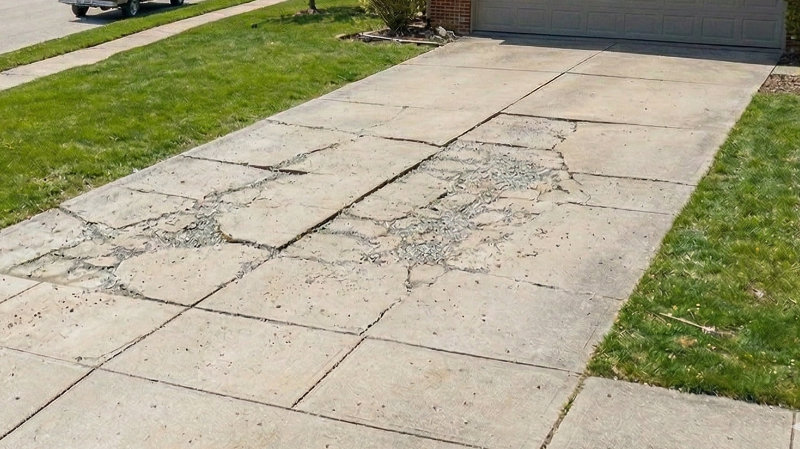
Every spring, homeowners in Troy and Rochester Hills walk out to their driveways and see the same thing: evidence of what another Michigan winter has done. The damage takes different forms — a new crack here, some surface flaking there, a section that seems to have shifted slightly — and it’s easy to feel uncertain about what it all means. Is this serious? Does it need immediate attention? Is it time to replace the whole thing, or can it wait another season?
The truth is that driveway damage is a language, and once you know how to read it, you can make much more confident decisions about what to do next. Different types of damage tell you different things about what’s happening beneath and within your concrete — and about whether your driveway has years of useful life remaining or whether it’s trying to tell you its time is running out.
Flat Rock Concrete Construction serves homeowners throughout Troy, Rochester Hills, and east Oakland County. In this guide, we’ll walk you through the most common types of post-winter driveway damage and explain honestly what each one means.
The Mechanism Behind Winter Driveway Damage
Before reading the damage, it helps to understand how it gets there. Michigan winters damage driveways through three primary mechanisms, and understanding each helps you interpret what you’re seeing.
Freeze-thaw cycling is the most powerful force. Water finds its way into any crack or pore in the concrete surface. When temperatures drop below 32 degrees, that water expands by about nine percent as it freezes. The expansion exerts tremendous pressure — up to 2,000 pounds per square inch — on the surrounding concrete. When temperatures rise above freezing, the water contracts and drains or evaporates, allowing more water to infiltrate before the next freeze. Over a winter with dozens of these cycles, the cumulative effect can transform a minor surface imperfection into a significant crack or cause surface layers to flake away entirely.
Chemical attack from de-icing salts works alongside freeze-thaw damage. Salt lowers the freezing point of water, which increases the number of freeze-thaw events the surface experiences. It also penetrates the concrete and disrupts the chemical bonds that hold the surface together, accelerating the scaling and spalling process. This is why driveway damage is often most severe near the garage apron and street edge — the areas where salt from plowing and vehicle tracking concentrates.
Frost heave works from below. When moisture in the soil beneath the driveway freezes and expands, it can push upward on the slab from below. In the clay-heavy soils common in parts of Oakland County, this can be significant. The result is sections of driveway that have risen relative to adjacent sections — a hazard and a sign of base vulnerability.
Surface Scaling: What It Means and What to Do
Surface scaling — the flaking or peeling of the concrete surface — is one of the most common complaints we hear from Troy and Rochester Hills homeowners in spring. It ranges from a light dusting of fine surface material to deep delamination that exposes the coarse aggregate below.
Light, isolated scaling in small areas is often a cosmetic issue rather than a structural one. It can result from de-icing salt concentration, a finishing technique that traps water in the surface layer, or minor variations in the original mix. In these cases, cleaning the affected area, applying a penetrating sealer, and monitoring the situation are reasonable first steps.
Widespread scaling across large portions of the driveway tells a different story. It typically indicates that the original concrete mix was not properly air-entrained for Michigan’s climate, or that the concrete was over-worked during finishing — a common mistake that brings excess water to the surface, creating a weak top layer particularly vulnerable to freeze-thaw damage. Widespread scaling cannot be fully corrected with surface treatments. Resurfacing can temporarily improve appearance, but the underlying vulnerability persists. Full replacement is often the more honest long-term recommendation.
Cracking: Reading the Pattern
Not all cracks are the same, and the pattern of cracking in your driveway is one of the most informative indicators of what’s happening structurally.
Hairline cracks — fine, shallow surface cracks with no vertical displacement — are common in concrete and are generally the result of normal thermal expansion and contraction. They become a concern only if they widen over time or allow significant water infiltration. Sealing them promptly and monitoring year over year is the appropriate response.
Map cracking or crazing — a network of fine interconnected cracks covering large areas of the surface — typically indicates that the surface dried too quickly during the original installation, or that de-icing chemicals have caused widespread surface deterioration. While not immediately structural, map cracking indicates that the slab’s surface integrity is compromised and will continue to deteriorate.
Linear cracks running parallel to the length of the driveway often result from side-tree root pressure, edge loading from vehicles driving along the edge, or insufficient support at the slab edges. In Rochester Hills neighborhoods with mature trees and heavily landscaped lots, root pressure is a common cause of longitudinal cracking.
Transverse cracks running across the full width of the driveway — particularly those with vertical displacement — are the most serious type. They indicate that the slab is experiencing significant bending stress, typically due to base failure, soil settlement, or frost heave. When you can rock one side of the crack relative to the other, the base beneath that section has failed. Repair of such cracks is generally a temporary measure at best.
Heaving and Settlement: The Base Is Talking
When you walk your driveway and notice that sections have shifted vertically — some higher, some lower than their neighbors — the driveway is telling you something important about its base. The surface damage you can see is just the visible symptom of a subsurface problem.
Heaving — upward displacement of a slab section — is most commonly caused by frost expansion in the soil beneath the slab. In a normal year, this movement reverses as the soil thaws, and the slab settles back toward its original position. But in areas where the base is inadequately compacted, drainage is poor, or repeated frost cycles have gradually shifted the base material, some of that heaving can become permanent.
Settlement — downward displacement — results from loss of support beneath the slab. This can be caused by soil erosion from poor drainage, by the natural compaction of inadequately prepared base material over time, or by organic material in the soil that has decomposed. Settled sections that have dropped significantly create water ponding and edge stress, which accelerate further deterioration.
Both conditions indicate that the base beneath your driveway is not providing the stable, uniform support the slab needs. Surface repair doesn’t address base problems. Mud-jacking can provide temporary re-leveling, but doesn’t fix the root cause. If heaving or settlement is significant or widespread, replacement with proper base preparation is the definitive solution.
Edge Damage: More Than Cosmetic
The edges of a concrete driveway are its most vulnerable point. They have less structural support than the field of the slab, they’re the first area contacted by snowplow blades, and they often bear the stress of vehicles whose tires roll partially off the edge of the surface.
Minor edge chipping — small pieces broken from the very edge — is cosmetic and can be patched with concrete repair compound. But significant edge crumbling or breakage, particularly if it extends several inches into the slab, indicates that the edge concrete has deteriorated to the point where it can no longer provide meaningful structural support to that section of the driveway.
In Troy and Rochester Hills, where many homeowners use professional plowing services, plow blade damage to edges is a common post-winter finding. If your plowing contractor is running their blade too close to the surface, the cumulative damage to edges over several seasons adds up.
When to Repair Versus When to Replace
After walking your driveway and cataloging the damage, the key question is whether repair makes economic sense or whether replacement is the smarter investment.
Repair makes sense when damage is limited in scope, isolated to small areas, and not indicative of base failure. Hairline cracks, minor surface scaling in a few spots, and small edge chips are all repair-appropriate findings. Repair buys meaningful additional life and doesn’t just delay an inevitable replacement.
Replacement makes sense when damage is widespread, when there is evidence of base failure (heaving, settlement, wide transverse cracks with displacement), when scaling affects large portions of the surface, or when the driveway is simply old enough that repeated repairs are no longer cost-effective. A concrete driveway in Troy or Rochester Hills installed in the 1970s and showing multiple types of significant damage has likely given good value, and the right move is to replace it with a quality installation that will serve the next owner of the property as well.
Flat Rock Concrete Construction offers free spring assessments for homeowners in Troy, Rochester Hills, and East Oakland County. We’ll walk your driveway with you, explain what we see, and give you an honest recommendation—not a sales pitch. Contact us this spring to schedule your assessment.
Contact Flat Rock Concrete Construction immediately at 586-726-6091 for expert guidance and priority scheduling of your concrete construction project before its schedule fills up.