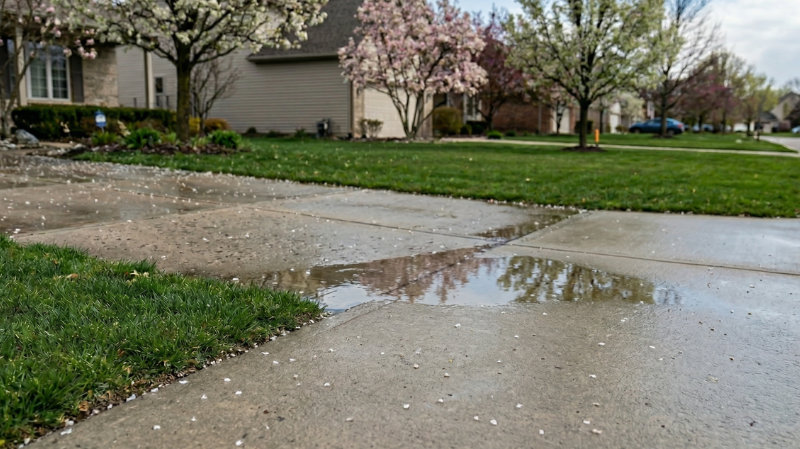
Spring arrives in Chesterfield Township and Washington Township, and homeowners are energized. The snow is melting, the ground is thawing, and all the home improvement projects that have been on hold since November suddenly feel urgent. Driveways that looked manageable under a blanket of snow reveal themselves for what they really are, and the calls to concrete contractors start coming in fast.
It’s exactly this combination — homeowner urgency and contractor demand — that creates the conditions for mistakes. Not malicious mistakes, but the predictable errors that come from moving too fast, not asking the right questions, or making assumptions based on incomplete information. These mistakes range from minor inconveniences to genuinely costly problems that can compromise a new driveway before it’s even had a chance to prove itself.
Flat Rock Concrete Construction, based in Utica, serves homeowners throughout Chesterfield Township, Washington Township, and northern Macomb County. Here are the most common spring driveway mistakes we see — and exactly how to avoid each one.
Mistake 1: Hiring the First Contractor Who Can Start Right Away
Spring scheduling pressure is real. Homeowners who waited too long to call contractors sometimes find that reputable crews are booked two to four weeks out. When a contractor calls back and says they can start Monday, that availability is genuinely appealing — especially if the driveway has become an urgent problem.
But contractor availability in peak season is inversely correlated with contractor quality more often than it should be. The best crews in northern Macomb County are busy because they do excellent work and have earned their reputations. When a contractor has immediate availability in late April or May, it’s worth asking why.
The right approach is to contact reputable contractors in early March — before the spring rush begins — and get on their schedules. Yes, you may wait a few weeks for the actual pour. But those few weeks are worth it to ensure you’re getting experienced crews, quality materials, and a contractor who will still be reachable if you have questions six months from now.
Before hiring anyone, ask directly: What concrete mix do you use? What is your base preparation process? Will you pull the required permits? Can you provide references from recent projects in this area? A contractor who can answer these questions clearly and confidently knows what they’re doing.
Mistake 2: Pouring Too Early in Spring
The eagerness to get a project done as soon as possible after a long Michigan winter is completely understandable. But in the concrete world, pouring too early in spring is one of the most reliable ways to compromise your investment.
Two conditions need to be met before a spring concrete pour is appropriate in Chesterfield and Washington Township. First, nighttime temperatures need to be consistently above 40 degrees Fahrenheit — ideally above 50. A single overnight freeze on fresh concrete in its early curing stages can cause permanent surface damage and internal weakness. Weather forecasts in early spring in northern Macomb County are unreliable, and a surprise frost on a two-day-old slab is a genuine disaster.
Second, the ground needs to be fully thawed. The frost line in northern Macomb County can reach 30 to 36 inches in a hard winter, and that frozen ground doesn’t thaw all at once. Pouring over soil that is still partially frozen beneath the gravel base creates a risk of heaving as the thaw completes after the pour. An experienced contractor will assess soil conditions before scheduling — and any contractor who doesn’t consider this question deserves your skepticism.
In most years, mid-April is the earliest realistic window for spring pours in Washington Township. Some years it’s late April. Patience at this stage pays dividends in the long-term performance of the finished driveway.
Mistake 3: Choosing Price Over Process
In any spring, a homeowner in Chesterfield Township can get multiple concrete driveway quotes that vary significantly in price. The temptation to choose the lowest quote is human nature — it’s the same square footage of driveway, so why pay more?
The answer is that what happens beneath and within the concrete matters enormously, and it’s invisible once the job is done. A contractor who saves money by installing two inches of gravel base instead of four, by using a lower PSI concrete mix without air-entrainment, or by rushing the curing process has delivered a product that looks identical to a quality installation on day one — but will perform very differently over the following decade.
When evaluating quotes, ask each contractor to specify: the depth and type of base material they will install; the PSI and admixture specifications of the concrete mix they will use; whether the mix is air-entrained; how control joints will be placed; and the curing process they will follow. A contractor who can speak specifically and confidently about each of these items is one who actually thinks about them. One who gives vague answers is telling you something important.
The price premium for quality concrete work in northern Macomb County is real but typically modest in percentage terms relative to the total project cost — and the difference in 20-year performance is not modest at all.
Mistake 4: Skipping the Sealer in the First Year
This is perhaps the most common mistake made by homeowners who did everything else right. They hired a good contractor, got a quality pour, waited the full curing period before driving on the new surface, and then drove through their first Michigan winter without ever applying a concrete sealer.
New concrete is more porous and more chemically vulnerable than mature concrete. The first winter — with its road salt, freeze-thaw cycles, and snowplow traffic — is actually the period when the surface is most at risk. A quality penetrating sealer applied in late summer or fall, after the concrete has fully cured for 90 days, creates a barrier that dramatically reduces water infiltration and slows the chemical attack from de-icing materials.
This is not a complex or expensive step. A quality penetrating sealer for a standard residential driveway costs $50 to $100 in materials and takes an afternoon to apply. The protection it provides in that critical first winter — and in subsequent years — is enormous relative to that investment.
Set a calendar reminder 90 days from the pour date: check the weather forecast and apply sealer. Then plan to reapply every five to seven years going forward.
Mistake 5: Using Rock Salt on a New Driveway
Related to the sealer mistake — and compounding it — is the use of rock salt or calcium chloride de-icers on a new concrete driveway in its first winter. This is one of the most common causes of surface scaling we see on driveways that were otherwise well-installed.
De-icing salts lower the freezing point of water by a chemical process that also attacks concrete surfaces. On mature, well-sealed concrete, this attack is manageable. On fresh concrete in its first winter, particularly if no sealer has been applied, de-icing chemicals can cause significant surface scaling — the flaking and pitting of the top layer of concrete — that permanently degrades the surface appearance and accelerates long-term deterioration.
The solution is simple: use sand on your new driveway for the first winter. Sand provides excellent traction on ice and snow without any chemical interaction with the concrete surface. Keep a bag of play sand or concrete sand in the garage and apply it as needed throughout the first winter. After the driveway’s first birthday — and after applying a quality sealer — you can transition to appropriate de-icing products if desired.
Mistake 6: Ignoring Drainage
Spring is the ideal time to observe and carefully consider the drainage around your driveway — both the driveway surface itself and the area around it. Many driveway problems that appear to be concrete quality issues are actually drainage issues in disguise.
A driveway that doesn’t drain properly — one that holds standing water on the surface or collects water at its base — is subjected to constant moisture stress, which accelerates deterioration. Standing water on the surface infiltrates cracks and drives freeze-thaw damage. Water that ponds at the base can saturate the subsoil and undermine the gravel base’s stability.
When planning a new driveway installation, discuss drainage with your contractor in detail. The finished driveway should have a slope of at least one to two percent — roughly 1/8 inch per foot — to direct surface water toward the street or a drainage swale. The base should be prepared to facilitate drainage through and around the gravel layer. And any existing drainage issues at the property level — downspouts that discharge near the driveway, or lawn grading that directs water toward the driveway — should be addressed as part of, or alongside, the driveway project.
Flat Rock Concrete Construction evaluates drainage conditions on every project site we assess in Chesterfield Township and Washington Township. We don’t pour concrete over a drainage problem and hope for the best — we identify issues in advance and address them as part of a complete, quality installation. Contact us this spring to schedule your free estimate and put your project on our calendar before the best weather windows fill up.
Contact Flat Rock Concrete Construction immediately at 586-726-6091 for expert guidance and priority scheduling of your concrete construction project before its schedule fills up.