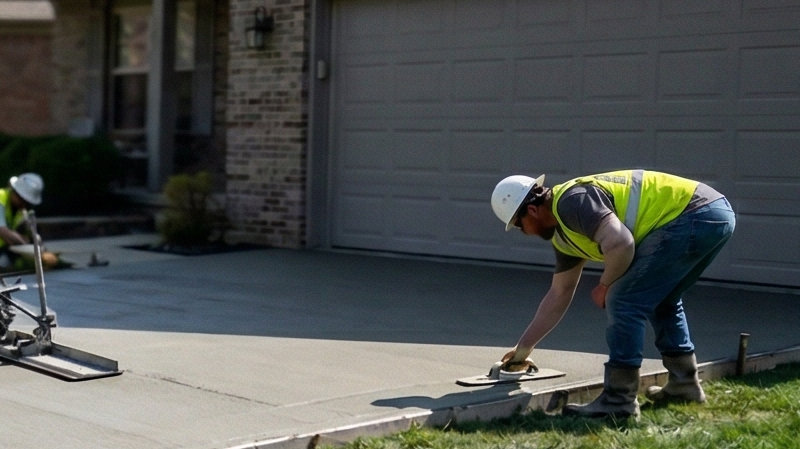
There’s a reason Flat Rock Concrete Construction’s phone starts ringing more consistently in March than at any other time of year. Spring is the prime concrete season in Michigan, and homeowners in Shelby Township and Macomb Township who have been watching their driveways deteriorate all winter long are ready to do something about it. But is spring actually the best time to pour a concrete driveway — or is that just contractor talk?
The honest answer is yes: spring is genuinely the best window for concrete driveway installation in Michigan, and the reasons are grounded in concrete curing science and the realities of our local climate. Understanding why helps you plan your project at the right time — and avoid the scheduling mistakes that lead to rushed jobs and compromised results.
The Science of Concrete Curing and Why Temperature Matters
Concrete doesn’t dry — it cures. This is an important distinction that many homeowners aren’t aware of, and it’s central to understanding why seasonal timing matters for driveway installation.
Curing is a chemical process called hydration, in which the water in the concrete mix reacts with Portland cement to form the crystalline structure that gives concrete its strength. This process works best within a specific temperature range — roughly 50 to 90 degrees Fahrenheit. Outside that range, curing is compromised, permanently affecting the strength and durability of the finished slab.
In extreme cold — below 40 degrees — hydration slows dramatically and can stop entirely if the concrete freezes before it has achieved adequate strength. Concrete that freezes in its early curing stages is permanently weakened and far more susceptible to surface scaling and structural cracking over its lifetime. Cold-weather pours are possible with proper precautions — heated enclosures, insulating blankets, and accelerating admixtures — but they add cost and complexity, and the margin for error is smaller.
In extreme heat — above 90 degrees — the water in the mix evaporates too quickly, which can cause plastic shrinkage cracking before the concrete even begins to set. Hot weather pours require additional water management, and the compressed working window puts pressure on finishing crews to move faster than ideal.
Spring in Shelby Township and Macomb Township — typically mid-April through early June — hits the sweet spot. Daytime temperatures are consistently in the 55 to 75 degree range, nights stay above freezing, and humidity levels support gradual, even moisture retention in the fresh concrete. These are nearly ideal curing conditions that allow the concrete to develop its full strength without temperature-related compromises.
Soil Conditions: Why Waiting for Full Frost Thaw Matters
In northern Macomb County, frost typically penetrates the ground to depths of 30 inches or more during a hard winter. That frozen ground doesn’t thaw from the surface down all at once — it thaws gradually, and until the thaw is complete, the soil beneath a potential pour site is still moving.
Pouring concrete over soil that hasn’t fully thawed is one of the most common mistakes made in early spring pours. The frozen subsoil expands as it thaws, which can cause a newly poured slab to heave, crack, or settle unevenly before it has even had a chance to cure properly. In Shelby Township and Macomb Township, where clay soils are common and hold moisture through the thaw season, this risk is real.
Experienced contractors know to assess soil conditions before scheduling a pour in early spring. The gravel base installed beneath the concrete provides some buffer, but if the subsoil beneath that base is still frozen or actively thawing, the project should wait. A pour executed two weeks later on fully thawed, stable soil will outperform an early pour on compromised ground every single time.
Contractor Availability: Why Acting Early in Spring Pays Off
The spring window for concrete work in Michigan is popular — and it fills up fast. By late April and into May, quality concrete contractors in Macomb County are scheduling projects two to four weeks out. By June, the best crews are often booked well into summer.
Homeowners who wait until they see a neighbor’s new driveway go in — or until their old one becomes an urgent problem — often find themselves squeezed into the tail end of the spring season or pushed into summer heat. Getting on a reputable contractor’s schedule in early March, even if the pour itself doesn’t happen until mid-April, gives you access to the best availability and the most favorable weather windows.
There’s also a practical benefit to early scheduling: it gives you time to make informed decisions. You can get multiple estimates, ask questions about mix specifications and base preparation, review the contractor’s approach without feeling rushed, and make a confident choice rather than a hurried one driven by a driveway that has become genuinely unusable.
Spring Also Gives Your Driveway Time to Cure Before Winter
This is an underappreciated advantage of spring installation that we emphasize to every Shelby Township and Macomb Township homeowner we talk to. A driveway poured in April or May has the entire summer and fall to cure and gain strength before it faces its first Michigan winter.
Fresh concrete is more vulnerable to de-icing salts than mature concrete. A slab that has had six or more months to cure and has been properly sealed before winter arrives is in a very different position than one poured in October that faces road salt, freeze-thaw cycles, and snowplow traffic within weeks of installation. Spring installation maximizes the curing window and lets you apply a high-quality penetrating sealer in late summer or fall — before the first freeze.
Compare this to a fall installation, which gives the concrete much less time to mature before its first winter stress test. While fall pours are certainly done — and done successfully — they require more careful management of curing conditions and offer less buffer time before the concrete faces real-world winter demands.
What to Do Right Now to Prepare for a Spring Installation
If you’re a Shelby Township or Macomb Township homeowner planning a spring driveway replacement, here’s what we recommend doing in March to set your project up for success.
- Walk your driveway carefully and document the damage — photos on your phone work perfectly. Note the location and severity of cracks, heaving, scaling, and drainage issues. This documentation helps your contractor understand the project’s scope before arriving for an estimate.
- Check with your township about permit requirements. Both Shelby Township and Macomb Township may require permits for driveway work, and processing time varies. Starting that process early ensures it doesn’t delay your project.
- Consider your access and logistics. Think about where a concrete truck will approach your driveway, whether any landscaping or obstacles need to be temporarily moved, and how you’ll manage without your driveway for the seven to ten days the new concrete needs before you can drive on it.
- Get on a contractor’s schedule. Contact Flat Rock Concrete Construction in March for a free estimate and to discuss scheduling. Our spring calendar fills quickly, and early contact gives you the best chance of securing your preferred timing.
- Plan for first-winter care. Budget for a quality penetrating concrete sealer to be applied in late summer or early fall after your spring installation. This is one of the most important steps you can take to protect your new driveway investment before its first Michigan winter.
Ready to Schedule Your Spring Installation?
Flat Rock Concrete Construction serves Shelby Township, Macomb Township, and the surrounding Macomb County communities from our base in Utica. We schedule spring projects starting in early March, and our calendar fills quickly — homeowners who contact us early get the best access to favorable spring weather windows and our most experienced crews.
Contact us today for a free estimate on your spring driveway project. We’ll come out, assess your site, and give you an honest, detailed proposal with clear information on timing, materials, and the installation process from start to finish.
Contact Flat Rock Concrete Construction immediately at 586-726-6091 for expert guidance and priority scheduling of your concrete construction project before its schedule fills up.