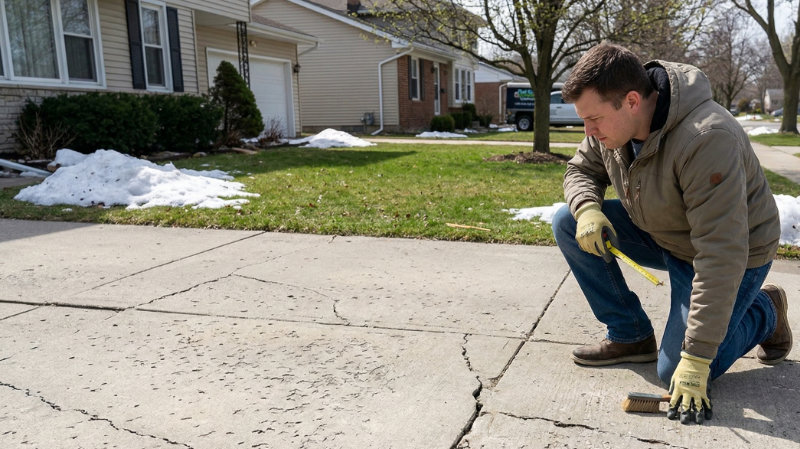
Every spring in Macomb County, the same scene plays out in driveways across Sterling Heights and Warren. The last of the snow melts away, the sun starts climbing higher in the sky, and homeowners step outside to take their first real look at their driveways since November. For some, it’s a pleasant surprise — the surface held up fine. For many others, it’s a moment of genuine concern. Cracks that weren’t there in October. Sections that have shifted. Surface flaking that seems to have appeared overnight.
What happened over those winter months, and what does it actually mean for your driveway? More importantly, what should you do about it? This guide is designed to help Sterling Heights and Warren homeowners conduct a thorough post-winter driveway assessment—and honestly determine whether what they’re seeing calls for a simple repair, preventive maintenance, or a full replacement.
Flat Rock Concrete Construction, based in Utica, serves homeowners throughout Macomb County. Spring is our busiest season, and the questions we hear most often in March and April are exactly the ones this article is designed to answer.
Why Michigan Winters Are So Hard on Driveways
To accurately assess winter damage, it helps to understand the mechanisms that cause it. Michigan’s winters don’t just bring cold — they bring a specific combination of conditions that is particularly destructive to concrete and asphalt surfaces alike.
Freeze-thaw cycling is the primary culprit. Throughout a typical Macomb County winter, temperatures fluctuate repeatedly across the freezing point. Water that has infiltrated surface cracks or the concrete’s pores freezes, expands by roughly 9% in volume, and exerts enormous pressure on the surrounding material. When it thaws, it contracts, allowing more water to enter before the next freeze. Over a winter with dozens of these cycles, even small surface imperfections can grow into significant structural problems.
Road salt and de-icers compound the damage. Salt lowers the freezing point of water, which actually increases the number of freeze-thaw cycles a surface experiences in a given winter — water that would have stayed frozen through a minor temperature fluctuation instead thaws and refreezes multiple times. Salt also attacks the chemical bonds in concrete through a process called chloride penetration, which over time weakens the surface and accelerates scaling.
Snowplow damage adds a mechanical dimension. In Sterling Heights and Warren, many homeowners use plowing services or plow their own driveways, and metal plow blades can chip, scratch, and gouge concrete surfaces — especially edges, control joints, and any areas where the surface was already slightly elevated or uneven.
Your Spring Driveway Inspection: What to Look For
Set aside 15 to 20 minutes on a dry day in early spring to walk your entire driveway carefully and note what you observe. Here’s what to look for and what each finding means.
Surface Scaling and Flaking
Scaling is the term for surface deterioration where the top layer of concrete peels away in thin flakes, exposing the aggregate below. It ranges from minor — small patches of surface roughness that don’t affect structural integrity — to severe, where large areas of the surface have deteriorated down to the coarse aggregate.
Minor scaling in isolated areas can be addressed with a concrete resurfacer, which is applied like a thin layer over the existing surface to restore smoothness and appearance. However, widespread scaling across large portions of the driveway is a sign that the original concrete mix or finishing process was compromised — either the mix wasn’t air-entrained for Michigan’s climate, or the surface was over-finished, weakening the top layer. When scaling is widespread, resurfacing may only be a temporary fix, and full replacement should be seriously considered.
Cracks: Not All Are Created Equal
Cracks are the most common concern homeowners bring to us in spring, and the honest answer is that not all cracks are serious. Here’s how to evaluate what you’re seeing.
Hairline cracks — fine surface cracks less than 1/16 of an inch wide — are common in concrete and generally not a structural concern. They can be sealed with a penetrating concrete sealer to prevent water infiltration and monitored over time. If they don’t widen significantly from year to year, they’re a cosmetic issue rather than a functional one.
Moderate cracks — those between 1/16 and 1/4 inch wide — deserve more attention. Fill these with a quality concrete crack filler as soon as possible in spring, before the summer rain season drives more water into them. Monitor them closely — if they continue to widen year over year, the underlying cause (unstable base, poor drainage, tree root pressure) needs to be addressed.
Wide or structural cracks — those wider than 1/4 inch, or any crack that shows vertical displacement between the two sides — are a serious concern. Vertical displacement indicates that the slab sections are moving independently, which suggests base failure or significant frost heave. At this point, the question is no longer whether to repair but whether repair is even worth doing, given that the underlying cause will continue to worsen.
Cracks that run the full width of the driveway, cracks that branch and spread in multiple directions, or multiple parallel cracks spaced closely together all suggest that the slab is under significant stress. In Sterling Heights and Warren, where many driveways date from the 1960s through the 1980s, patterns like this often mean the driveway has simply reached the end of its useful life.
Heaving and Settlement
Walk your driveway carefully and look for sections that have shifted vertically relative to adjacent sections. Even a half-inch of elevation change at a joint or crack is a trip hazard and a sign that the base beneath the slab has moved.
Heaving — where a section has risen above its neighbors — is typically caused by frost expansion beneath the slab or tree root pressure from below. Settlement — where a section has dropped — is caused by base erosion, soil compaction failure, or loss of material beneath the slab. Both indicate base problems that surface repair cannot fix.
If you find heaving or settlement, the realistic options are either to mud-jack the affected slab sections (a process of pumping grout beneath the slab to re-level it) or to replace the affected area entirely. Mud-jacking can be cost-effective for isolated sections, but it doesn’t address the underlying base problems, which means it may need to be repeated. Full replacement of affected sections — or the entire driveway if problems are widespread — is often the better long-term solution.
Edge Deterioration and Joint Damage
Pay special attention to the edges of your driveway and the control joints. Edges are more vulnerable than the slab’s field because they have less support on one side. Chipping, crumbling, or breakage at the edges can result from plow damage, heavy vehicles driving off the edge, or just age and weathering. Edge deterioration that is limited and shallow can be repaired with hydraulic cement or concrete patching compound. Extensive edge damage along the full length of the driveway is a sign of more systemic deterioration.
Control joints — the lines cut across the driveway — should be clean and well-defined. If joint edges are crumbling or the joint itself has filled with debris, allowing adjacent sections to begin locking together, water infiltration and cracking are likely to follow.
Drainage Issues
Spring snowmelt is an excellent time to observe how water flows across and away from your driveway. Watch during or after a rain event. Water should flow smoothly off the driveway surface toward the street or a designated drainage area — it should not pool on the surface or, worse, drain toward your home’s foundation.
Pooling water on the driveway surface indicates either that the surface has settled unevenly, creating low spots, or that the original slope was insufficient. Both situations accelerate freeze-thaw damage because standing water has more opportunity to infiltrate the surface. Drainage toward the foundation is a more urgent concern — it can contribute to basement water infiltration and foundation problems.
Repair or Replace: Making the Call
After your inspection, you’ll likely fall into one of three categories. If damage is limited to hairline cracks and minor surface scaling in isolated areas, you’re in maintenance territory — seal the cracks, apply a penetrating sealer, and monitor going forward. If you’re seeing moderate cracking, some edge damage, and perhaps minor scaling in larger areas, targeted repairs are worth doing — but get an honest assessment from a contractor about whether those repairs buy you meaningful additional life or just delay the inevitable. If you’re seeing widespread cracking, heaving or settlement, extensive scaling, or drainage problems, replacement is almost certainly the more economical long-term choice.
Flat Rock Concrete Construction offers free assessments for Sterling Heights and Warren homeowners who aren’t sure which category they fall into. We’ll come out, walk the driveway with you, and give you an honest opinion — not a sales pitch. Contact us this spring to schedule your free driveway assessment.
Contact Flat Rock Concrete Construction immediately at 586-726-6091 for expert guidance and priority scheduling of your concrete construction project before its schedule fills up.